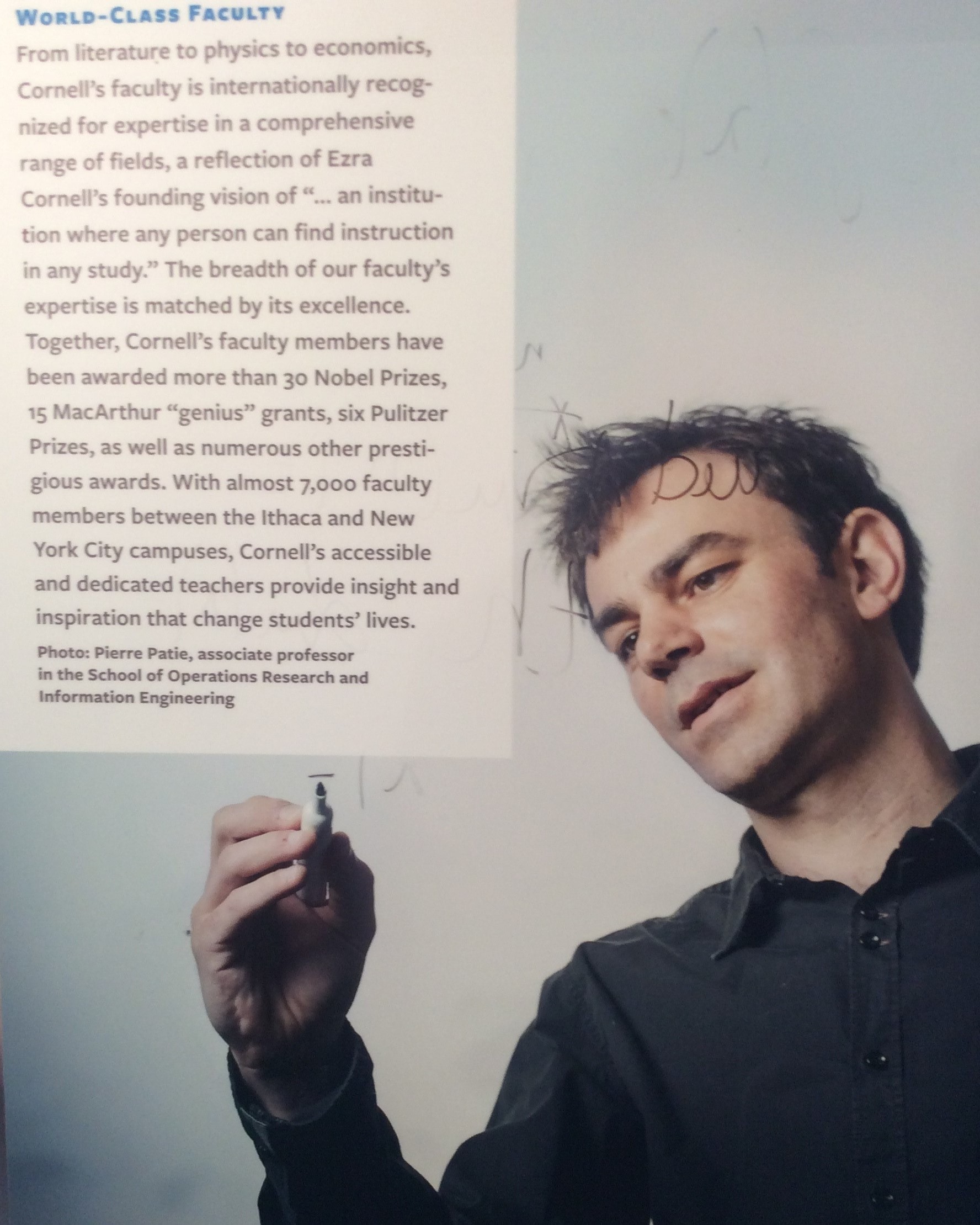
Pierre Patie
I am broadly interested in the study and applications of linear operators and related objects. This encompasses the following topics:Isospectral classes of linear operators: (pseudo-) unitary conjugation, Markov interwining, interweaving, gateway (duality) and weak similarity orbit
↬ Spectral and perturbation theory of (non)-selfadjoint operators
↬ Convergence to equilibrium, hypocoercivity, hyper(ultra)contractivity, cut-off phenomena
↬ Scaling limit and universality
↬ Representation theory and operator algebra
Potential theory of Markov processes
↬ Martin boundary and exit problems for (non)-Markovian processes with jumps
↬ Boundary crossing problems
↬ Optimal stopping problems
Computational mathematics
Special topics: Self-similar Markov processes, Exponential functional of Lévy processes, Subdiffusive processes, The moment problem, Special functions, Asymptotic analysis, Financial and insurance mathematics and Neurology
Publications
Full list of Publications and my
 ORCID Profile
 Submitted
- Novel visions in the theory of self-adjoint operators through the lens of algebras
- Isospectral schemes for exact algorithms for stochastic processes and PDE's with A. Chee, X.Y. Han, Y. Liu, R. Sarkar and T. Tian
- Fluctuation theory of continuous-time skip-free downward Markov chains with applications to branching processes with immigration with R.L. Loeffen and J. Wang
- Non-local heat equation with moving boundary and curve-crossing of delayed Brownian motion with G. Ascione and B. Toaldo
Some recently published/accepted papers
- Jacobi processes with jumps as neuronal models: a first passage time analysis with G. D'Onofrio and L. Sacerdote,
SIAM Journal on Applied Mathematics, 2023 - Weak similarity orbit of (log)-self-similar semigroups in the Euclidean space with R. Sarkar
Proceedings of the London Mathematical Society, 2023 - A new class of solutions to the van Dantzig problem, the Lee-Yang property and the Riemann hypothesis with T. Konstantopoulos and R. Sarkar
Annales de l'Institut Fourier, 2023 - First passage times over stochastic boundaries for subdiffusive processes with C. Constantinescu and R.L. Loeffen
Transactions of the American Mathematical Society, 2022 - Discrete self-similar and ergodic Markov chains with L. Miclo and R. Sarkar
Annals of Probability, 2022 - Non-classical Tauberian and Abelian type criteria for the moment problem with A. Vaidyanathan
Mathematische Nachrichten, 2022 -
Spectral expansions of non-self-adjoint generalized Laguerre semigroups
with M.
Savov
Memoirs of the American Mathematical Society, 2021 - On interweaving relations with L. Miclo
Journal of Functional Analysis, 2021 - On non-local ergodic Jacobi semigroups: spectral theory, convergence-to-equilibrium and contractivity with P. Cheridito, A. Srapionyan and A. Vaidyanathan
Journal de l'Ecole Polytechnique - Mathématiques, 2021 - Risk-neutral pricing techniques and examples with R. A. Jarrow, A. Srapionyan and Y. Zhao
Mathematical Finance, 2021 - A spectral approach for hypocoercivity applied to some degenerate hypoelliptic, and non-local operators with with A. Vaidyanathan
Kinetic and Related Models, 2020 -
Intertwining, excursion theory and Krein theory of strings for non-self-adjoint Markov semigroups
with M.
Savov and Y. Zhao
Annals of Probability, 2019 - Skip-free Markov chains with M.C.H. Choi
Transactions of the American Mathematical Society, 2019 - Extinction time of non-Markovian self-similar processes, persistence, annihilation of jumps and the Fréchet distribution with R.L. Loeffen and M.
Savov
Journal of Statistical Physics, 2019 - On a gateway between continuous
and discrete Bessel and Laguerre processes with L. Miclo
Annales Henri Lebesgue, 2019 -
Bernstein-gamma functions and exponential functionals of Lévy Processes
with M.
Savov
Electronic Journal of Probability, 2018 - Cauchy problem of the non-self-adjoint Gauss-Laguerre semigroups and uniform
bounds of generalized Laguerre polynomials with M.
Savov
Journal of Spectral Theory, 2017 - Boundary crossing identities for Brownian motion
and some
nonlinear
ode's with L.
Alili
Proceedings of American Mathematical Society, 2014 - Law of the
absorption time of positive self-similar Markov processes
Annals of Probability, 2012
List of co-authors: L. Alili, G. Ascione, F. Avram, C. Bartholmé, L. Chaumont, M. Chazal, A. Chee, P. Cheridito, M.C.H. Choi, M. Cissé, C. Constantinescu, G. D'Onofrio, P. Embrechts, R. Frey, X.Y. Han, B. Jarrow, R. Kaufmann, T. Konstantopoulos, A. Kyprianou, Y. Liu, R.L. Loeffen, L. Miclo, J.-C. Pardo, J.L. Pedersen, L. Sacerdote, R. Sarkar, M. Savov, T. Simon, A. Srapionyan, E. Tanré, T. Tian, B. Toaldo, A. Vaidyanathan, S. Vakeroudis, J. Wang, C . Winter, Y. Zhao
PhD Students
Here are the PhD students I have/had the chance to work with:
- Filip Stojanovic (ORIE, Cornell), since 2023
- Andrew Chee (ORIE, Cornell), 2023
Algebraic, analytical and numerical perspectives on the universe of integrable systems - Rohan Sarkar (ORIE, Cornell), 2021
Continuous and discrete self-similarity via classification schemes of Markov processes, and the van Dantzig problem - Jian Wang (ORIE, Cornell), 2020
Continuous time skip-free Markov process and study of branching process with immigration - Aditya Vaidyanathan (CAM, Cornell), 2019
Contributions to the Stieltjes moment problems and to the intertwining of Markov semigroups - Anna Srapyonian (CAM, Cornell), 2019
Some spectral ideas applied to finance and to self-similar and long-range dependent processes - Michael C.H. Choi (ORIE, Cornell), 2017
Analysis of non-reversible Markov chains - Yixuan Zhao (ORIE, Cornell), 2017
Spectral expansions and excursion theory for non-self-adjoint Markov semigroups with applications in mathematical finance - Christopher Van Weverberg (ULB), co-supervised with G. Deelstra, 2015
Contributions to the study of affine processes with applications in insurance - Carine Bartholmé (ULB), 2014
Self-similarity and exponential functionals of Lévy processes
Seminars
- Cornell Probability Seminar
- ORIE colloquium
- Finger Lakes Probability Seminar, Birmingham, February 24-25th, 2023
- Intertwining between Probability, Analysis and Statistical Physics, IMS Workshop, Singapore, 05-15th Aug 2024
